

From Static Diagrams to Real-Time Architecture Visibility
Discover why traditional architecture diagrams are no longer enough for modern cloud environments and how real-time visibility helps teams make better technical and business decisions.
 Georgian Zaharia
 Ana Briscan
June 16, 2026
Efficiency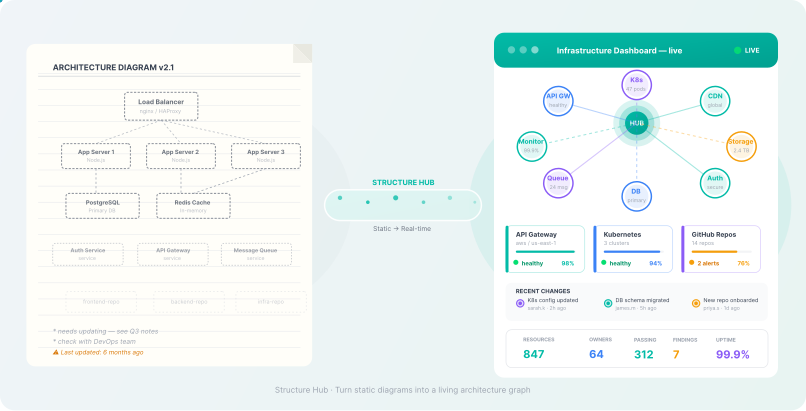
Introduction
Architecture diagrams have always been important for understanding how systems are designed, connected, and operated. They help teams explain technical decisions, onboard new engineers, plan changes, investigate incidents, and communicate with business stakeholders.
However, in many organizations, architecture diagrams are still created manually and updated occasionally. This creates a serious problem: the moment infrastructure changes, the diagram starts becoming outdated.
In modern cloud, hybrid, and distributed environments, this happens constantly. New services are deployed, infrastructure is resized, repositories evolve, networking rules change, and teams create or remove resources every day. A static diagram can no longer represent a dynamic environment with confidence.
Structure Hub is designed to solve this problem by moving architecture visibility from static documentation to real-time operational intelligence.
The Problem with Static Architecture Diagrams
Most architecture diagrams are created with good intentions. A team documents the current system, adds cloud resources, maps a few dependencies, and shares the diagram across the organization.
But over time, several issues appear:
The diagram no longer reflects the real infrastructure.
New components are added without being documented.
Dependencies between services are not updated.
Ownership information becomes unclear.
Teams begin to rely on verbal explanations instead of trusted documentation.
Business and technical stakeholders lose confidence in the information.
This creates a gap between the architecture people think they have and the architecture that actually exists.
That gap can become expensive. It can slow down delivery, increase operational risk, complicate audits, and make incident response more difficult.
Why Real-Time Architecture Visibility Matters
Real-time architecture visibility allows teams to understand the current state of their infrastructure and applications without manually rebuilding diagrams every time something changes.
With Structure Hub, organizations can connect cloud environments, repositories, applications, infrastructure components, and related systems into a live architecture view. Instead of relying on disconnected tools and manual updates, teams get a continuously updated representation of the technology landscape.
This means architects, DevOps engineers, SREs, platform teams, system administrators, and IT leaders can all work from the same source of truth.
What Structure Hub Enables
Structure Hub helps teams move from static diagrams to dynamic architecture intelligence by providing:
Real-time infrastructure and application diagrams.
Cloud resource visibility across supported environments.
Application-to-infrastructure relationship mapping.
Repository and service connections.
Dependency visualization.
Version history and change monitoring.
AI-generated documentation connected to the architecture view.
Better support for governance, audits, cost visibility, and operational decisions.
The result is not just a better diagram. It is a better way to understand how technology works inside the organization.
Business Value
Real-time architecture visibility creates value across multiple levels of the organization.
For engineering teams, it reduces the time spent searching for information. For architects, it provides a stronger foundation for decision-making. For DevOps and SRE teams, it improves operational awareness. For leadership, it creates clearer visibility into technology complexity, risk, cost, and governance.
Most importantly, it reduces dependency on tribal knowledge.
When information exists only in the minds of a few engineers, the organization becomes vulnerable. Structure Hub helps transform that knowledge into a shared, structured, and always-accessible asset.
Conclusion
Architecture should no longer be treated as a static artifact that is updated once per quarter. In modern environments, architecture must become a living operational capability.
Structure Hub helps organizations understand what exists, how systems are connected, how they change, and what impact those changes may have.
Real-time visibility is not only a technical feature. It is a foundation for better governance, faster onboarding, safer delivery, and smarter technology decisions.